
Celebrating Cebu's Sinulog Festival
In the vibrant heart of the Philippines, every third Sunday of January, the island of Cebu transforms into a pulsating sea of color, faith, and rhythmic movement. This is the Sinulog Festival, a spectacle that transcends mere celebration to become a profound expression of history, devotion, and community identity. More than just the country’s most famous fiesta, Sinulog is a living tapestry woven from the threads of Cebu’s ancient animist past and its deep-rooted Catholic present, a dynamic performance where every chant and step tells a story of transformation.
At its core, Sinulog is a devotional dance honoring the Santo Niño, the Holy Child Jesus. The festival’s name derives from the Cebuano word “*sulog*,” meaning “like water current movement,” a perfect description of the signature two-step forward, one-step backward dance that mimics the flow of the Pahina River. This simple, swaying motion is believed to have originated as a pagan ritual to native gods, a rhythm that was seamlessly adopted in 1521 when Ferdinand Magellan presented the image of the Santo Niño to Rajah Humabon and Queen Juana as a symbol of their baptism. The dance became a tool of evangelization, a physical prayer of acceptance. Today, millions of devotees, from infants in their parents’ arms to the elderly, perform this sacred step in a grand procession, their hands raised in supplication or clutching their own Santo Niño images, chanting “Pit Señor!” (short for *Viva el Señor*), in a powerful, collective cry of faith.
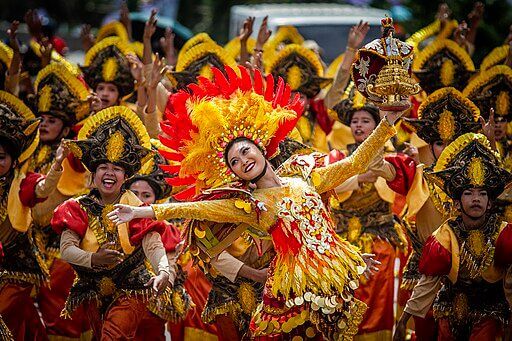
Celebration of the Sinulog Festival
Yet, Sinulog is also a feverish explosion of cultural pride and artistic brilliance. The Grand Street Parade is a breathtaking marathon of competing contingents, where thousands of dancers in meticulously crafted, kaleidoscopic costumes move with hypnotic precision to the thunderous beat of drums, trumpets, and native gongs. Each group presents elaborate street theater, depicting not only the Christianization of the islands but also folklore, historical battles, and visions of a harmonious future. The streets of Cebu City become a stage for a million spectators, all swaying in unison, united by the infectious energy. It is a sensory overload of vibrant hues, powerful music, and the sheer, joyful exhaustion of participants who have poured their hearts into months of practice.
To experience Sinulog is to understand the soul of Cebuano culture—a culture that embraces its complex history with joy rather than contradiction. It is where solemn religious fervor walks hand-in-hand with unbridled merrymaking, where ancient rituals find new expression in modern choreography, and where the entire community, from the poorest barangay to the most influential corporation, contributes to the spectacle. The festival is a testament to resilience, a yearly reaffirmation of identity, and a heartfelt thanksgiving. It is more than a party; it is the rhythmic heartbeat of a people, a powerful, dancing prayer that echoes through the streets, inviting all to witness and feel the enduring spirit of Cebu and the Philippines.